
Join the Sun Plans mailing list!


Enter your e-mail address and click JOIN:

JOIN
  passive solar
solar energy
basic principles
art of design
sun inspired
ours vs theirs

more information

solar FAQs

news and notices


Basic Passive Solar Principles

1. Choose a site that receives south sun

No tall trees, buildings, or hillsides to the south. When in doubt, go out around Dec. 21 when the sun is the lowest in the sky. The south side of the house should receive full sun from 9 a.m. to 3 p.m. You can use a compass to help find south, but compasses point to magnetic north, which can vary by as much as 25 degrees from true north, so check with your surveyor.

2. Choose a design with few projections and porches on the south

Projections shade adjacent windows, and porches on the south prevent the sun from entering. Porches on the east and west can be beneficial, as they shade east and windows from the hot summer sun.

3. Orient the longest wall of your house to the south

This south wall can be the front, back, or side of the house. Ideally it should be within 15 degrees of true south.

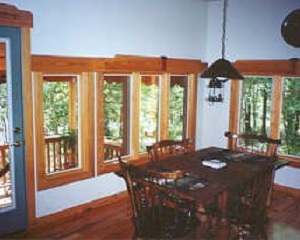
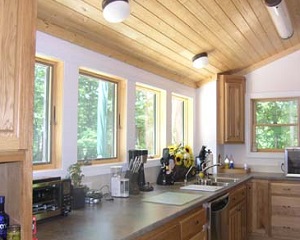
4. Maximize windows on the south side

South glass should be a minimum of 7% of the house square footage, and maximum of 12% unless isolated sunspaces are used. You must also be careful to choose south glass with a high solar heat gain coefficient as some low-emissivity coatings block too much sun.

5. Design the overhangs to properly shade from the high summer sun

Window overhangs are among the most important components of passive solar homes. A rough rule of thumb is that a two foot overhang shades an eight to nine foot wall well in most locations. An excellent tool for overhang design is at the Sustainable By Design web site, and for a small fee you can have your overhang professionally designed by the author of that web site to ensure maximum performance. Overhang design is affected by the height of the walls, roof construction method, height of the windows, latitude, and the orientation of your wall compared to due south.

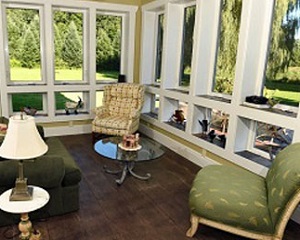
6. Provide thermal mass

Provide tile, brick, stone, or colored concrete floors or walls inside the south side of the building to absorb and release heat. This is where concrete slab-on-grade foundations can be appropriate. A very rough rule of thumb is to add 8 s.f. of mass 4" thick for every 1 s.f. of south glass above the 7% minimum. The exact amount varies depending upon whether the surfaces receive full sun, or are just in the room.

Energy Efficiency Strategies

7. Insulate and seal your house

Careful attention to detail is essential. Insulation should not be compressed and no air should leak in. If you can't get as much south glass as you would like, then extra insulation can result in the same overall lowered energy consumption.

8. Properly design your heating and cooling system

Systems should be properly sized and installed, which often includes a fresh air ventilation system. If you are at home a lot, this would entail simply opening a window. Homes should have one-third of an air change per hour and you can have a blower door test run by the better heating and air conditioning contractors to verify this. This rating means that every 3 hours the entire volume of air in the house is replaced. If it is found to be tighter than this, you can add mechanical ventilation. Personally, I found that even trying hard (caulking everywhere), it was difficult to make the house too tight.

next: The Art of Passive Solar Design

The contents of this site are copyright © 2009, 2002 Sun Plans Inc.
All Rights Reserved. This material may not be reproduced or redistributed
without prior written permission. Please contact us for permission to
use or modify our designs and information. Thanks!


Under Construction
Our web site is being redesigned. Please send us comments about your likes and dislikes of sunplans.com as well as what you would like to see.

Please enter your comments about our current web site, and what you'd like to see in the new site:


Please optionally enter your e-mail address if you'd like to be added to our e-newsletter list:


SEND FEEDBACK